
How is Alpha-1 inherited?
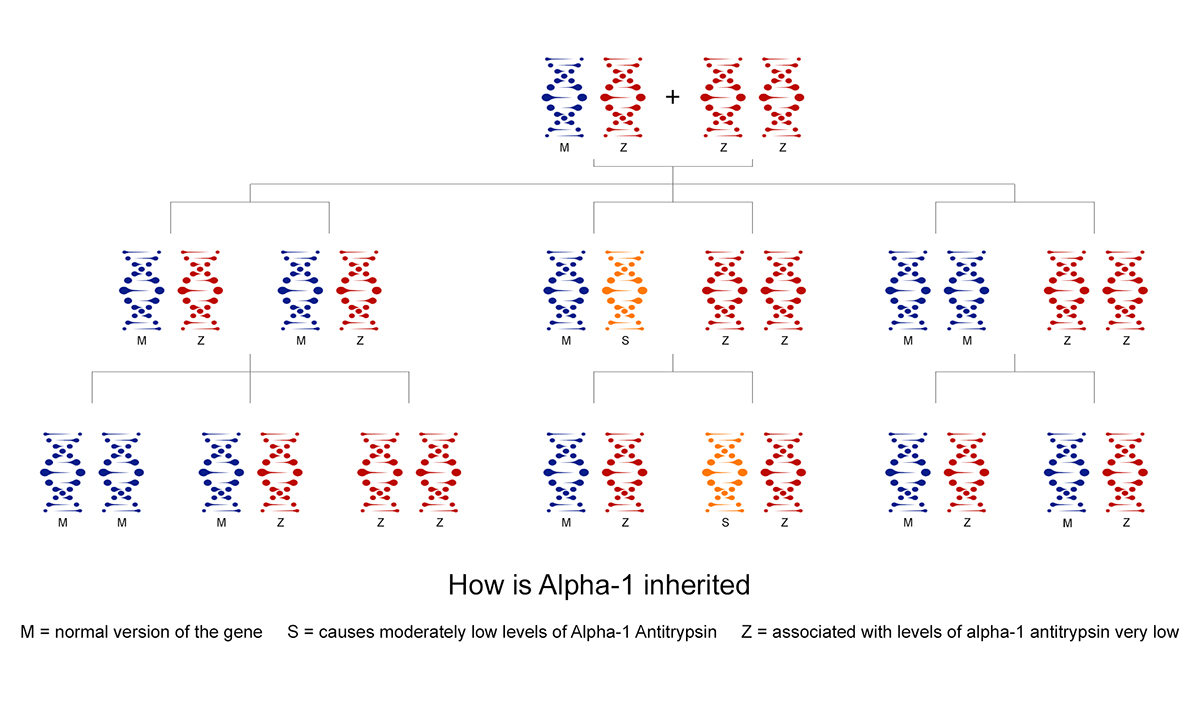
As I said at the beginning, alpha-1 antitrypsin deficiency is a genetically transmitted disease, with the child inheriting one gene from the father and one from the mother.
Below you will find the image with the transmission mode and variants encountered most frequently:
- Normal (MM) – Does not have the disorder; does not carry any abnormal Alpha-1 Antitrypsin genes.
- Carrier (MZ) – Mild to moderate Alpha-1 Antitrypsin Deficiency. There may be disease symptoms and does carry an abnormal Alpha-1 Antitrypsin gene. Even if they are carriers, if they smoke, they have a high risk of COPD, which is why they should quit smoking and lead a healthy lifestyle.
- Carrier (MS) – Does carry an abnormal Alpha-1 Antitrypsin gene but It is unclear whether there is a risk for getting disease symptoms.
- Alpha-1 (SZ) or (ZZ) – Moderate (SZ) to severe (ZZ) deficiency — could get disease and does carry two abnormal AAT genes.
- Alpha-1 (SS) – Does carry two abnormal Alpha-1 Antitrypsin genes but It is unclear whether there is a risk for getting disease symptoms.
- Null – Null – Null mutations don’t produce alpha-1 antitrypsin, so alpha-1 antitrypsin is not produced in the liver or is not found in the blood. There are many different null mutations.
People who have a normal gene (M) and a deficient gene (Z) are known as carriers because they can pass on the deficient gene to their offspring. Carriers may also suffer from the symptoms of the deficit, but the risk is lower.
Carriers have a 50% chance of passing on their abnormal Alpha-1 gene to their children, so children have a 50% chance of being carriers, but there is also a risk of having children with severe Alpha-1 Antitrypsin deficiency if both parents are carriers, inheriting an abnormal gene from the mother and one from the father.
People who have two damaged copies of the gene cannot produce enough Alpha-1 Antitrypsin, which causes more severe symptoms of the disease.
In addition to the most common S and Z alleles that cause Alpha-1 Antitrypsin deficiency, there are at least 30 additional rare alleles that are associated with low or no Alpha-1 Antitrypsin levels. More details can be found by accessing the following link: www.a1adsupport.com/genetics/phenotypes/rare-alleles.